Mold Inspection & Testing in Chicago
Illinois does not license mold assessment professionals at the state level — unlike Florida (Chapter 468), Texas, New York and a handful of other states. That means Chicago property owners evaluating an assessment quote have to weigh credentials that actually substantiate the work: industry certification, use of AIHA-accredited laboratories for sample analysis, and adherence to published assessment standards (ASTM and IICRC). Water Mold Fire Restoration of Chicago is IICRC Firm Certified, performs assessments to ASTM and IICRC documentation standards, and uses AIHA-accredited labs for all sample analysis. We perform inspections and testing for real estate transactions, post-frozen-pipe-burst and post-sewer-backup losses, basement IAQ concerns, two-flat and condo HOA disputes, insurance claims and post-remediation verification across Cook County and Chicagoland.
When Chicago Properties Need a Mold Inspection
In a city with damp basements as a near-universal feature, housing stock that runs back to the 1880s, and a winter cycle that produces predictable frozen-pipe-burst surges every few years, "I want to know what's actually in this property" is one of the most reasonable things a Chicago property owner or buyer can ask. The most common scenarios:
- Pre-purchase real estate inspections. Chicago's housing inventory — bungalows, two-flats, three-flats, greystones, workers' cottages, lakefront high-rise condos — carries hidden-mold profiles that standard home inspections will not surface. Most Chicago home inspectors do not perform air sampling and are limited to visual checks and moisture meter readings. An independent MRI-style mold assessment tells you what's actually behind the drywall, in the basement floor cavity, in the attic insulation and in the HVAC system before you close.
- Post-frozen-pipe-burst assessments. After the January 2014, January 2019 and January 2024 polar vortex burst surges, thousands of Chicago homeowners had mitigation performed under enormous time pressure. Many bursts went undetected for days while owners were out of town. An independent assessment confirms whether the drying actually succeeded or whether mold has colonized behind finishes and inside framing cavities.
- Post-sewer-backup assessments. Sewer backup water is Category 3 ("black water") under IICRC S500 and seeds aggressive mold colonization even after prompt cleanup. After the July 2023 Lower West Side flooding and the July 2024 Northwest Side rainfall events, post-backup mold assessment work ran for months in the affected basements and garden units.
- Basement and crawlspace assessments. Chicago basements are almost universally damp because of clay-soil water tables. Field-stone foundations in vintage bungalows wick groundwater; poured concrete foundations crack at the cold joint; block foundations leak at the mortar lines. Visible staining, musty smell, recurring condensation on cold-water lines, peeling paint at the base of walls — all classic Chicago basement mold indicators that benefit from instrument and lab confirmation.
- Two-flat and condo HOA disputes. Chicago's two-flat, three-flat, 6-flat and condo stock all produce recurring disputes over which unit's plumbing caused the leak and which party owns the resulting mold remediation. Independent neutral assessment is usually the fastest path through the stalemate.
- Indoor air quality (IAQ) testing. Unexplained respiratory symptoms, persistent musty smell, new-occupant complaints in a rental, or due-diligence baseline testing for a buyer with allergy or asthma concerns. We perform IAQ-focused sampling protocols beyond the standard mold scope when warranted.
- Insurance claim documentation. Illinois insurance carriers increasingly require independent mold assessment documentation on water claims of significant size before closing them out. Our reports are written to meet that standard.
- Post-Remediation Verification (PRV). Independent verification that a completed mold remediation actually worked. EPA, IICRC and ASTM all recommend PRV by an independent third party on significant jobs.
Illinois Mold Regulation & Why Independence Still Matters
Illinois does not license mold assessment or mold remediation contractors. The Illinois Department of Public Health publishes consumer guidance documents, but no individual or company license is required to perform either service. This is different from Florida, where Chapter 468, Part XVI of the Florida Statutes requires separate Mold Assessor (MRSA) and Mold Remediator (MRSR) licenses and where Statute § 468.8419 prohibits the same company from doing both on the same project.
Illinois doesn't impose that separation by law, but the published industry consensus — the EPA's Mold Remediation in Schools and Commercial Buildings guidance, the IICRC S520 Standard for Professional Mold Remediation, and the ASTM E2418 Standard Guide for Readily Observable Moisture Affecting Indoor Materials — all recommend that mold assessment and mold remediation be performed by independent parties on significant jobs. The reasoning is the same in Illinois as it is in Florida: an assessor who is also bidding the remediation contract has an incentive to oversize the findings, and a remediator performing its own clearance has an incentive to undersize them.
We follow that best practice voluntarily. We perform our own mold remediation service in Illinois (a legal scope here), and we perform assessment and testing on the same property when warranted. For insurance-driven and large-scope jobs, we recommend independent third-party post-remediation verification — and we can coordinate with independent IAQ assessors when that separation matters to the claim or to the parties involved.
Our Mold Inspection & Testing Process
- Pre-inspection consult. Reason for assessment, property history, recent water events (frozen pipe burst, sewer backup, ice dam), occupant health concerns.
- On-site visual inspection. Systematic walkthrough with photo documentation. Basement, mechanical rooms, kitchen and bathroom plumbing chases, attic, HVAC closets and supply runs.
- Moisture mapping & thermal imaging. Calibrated meters and thermographic camera locate hidden moisture in walls, ceilings, floor cavities and around plumbing penetrations.
- Air sampling (spore trap). Outdoor baseline + indoor samples for lab comparison.
- Surface sampling. Tape lifts, swabs, bulk samples for direct identification.
- AIHA-accredited lab analysis. Standard 3-5 business days; rush 24-48 hours.
- Written assessment report. Photos, moisture mapping, thermal images, lab results, interpretation, and (where mold is confirmed) a recommended remediation scope.
Types of Testing We Perform
- Air sampling (spore trap). Indoor vs. outdoor airborne spore comparison.
- Surface sampling. Species ID via tape lift, swab, settled dust.
- Bulk sampling. Direct examination of suspect materials.
- HVAC sampling. Air handler and duct sampling for system contamination — particularly important in tight new-construction Chicago condos.
- Basement & crawlspace sampling. Chicago bungalows, two-flats, and pre-WWII single-family stock with damp foundations.
- Attic sampling. Ice-dam-origin attic mold detection in older Chicago housing.
- Indoor Air Quality (IAQ) testing. Broader sampling for occupant health concerns.
- Post-Remediation Verification. Independent verification against the original remediation scope.
Where We Inspect & Test in Chicago
Lakeview, Wrigleyville, Boystown, Lincoln Park, Old Town, Gold Coast, Streeterville, River North, the Loop, West Loop, Fulton Market, South Loop, Pilsen, Bridgeport, Hyde Park, Kenwood, Bronzeville, Beverly, Logan Square, Wicker Park, Bucktown, Humboldt Park, Avondale, Lincoln Square, Andersonville, Edgewater, Uptown, Rogers Park, North Center, Roscoe Village, Irving Park, Albany Park, Portage Park, Jefferson Park, the bungalow belt, and suburban Evanston, Skokie, Wilmette, Glenview, Northbrook, Park Ridge, Arlington Heights, Schaumburg, Naperville, Oak Park, Berwyn and Cicero. Real estate closings and insurance deadlines often run tight — we schedule rush appointments where the calendar allows.
Chicago Mold Inspection & Testing FAQs
No. Illinois does not require state licensure for mold assessment or remediation. The meaningful credentials are IICRC Firm certification, adherence to ASTM and IICRC assessment standards, and use of AIHA-accredited laboratories.
Strongly recommended for any pre-WWII bungalow, two-flat, three-flat, greystone or workers' cottage. Standard Chicago home inspections do not include air sampling. Basement, attic and HVAC moisture profiles are not visible from the showing walkthrough.
Inspection is visual/instrument-based; testing is lab analysis of samples collected during inspection. Most Chicago assessments include both.
EPA, IICRC and ASTM all recommend independent third-party PRV on significant jobs — even though Illinois doesn't require it (Florida does). The reasoning is conflict-of-interest removal: an assessor bidding the remediation has incentive to oversize; a remediator self-clearing has incentive to undersize.
Yes, if the water sat more than 48 hours before mitigation, or if mitigation was rushed during a citywide event (the January 2014, 2019, 2024 polar vortex bursts; July 2023 and 2024 sewer-backup floods). Independent assessment confirms drying succeeded and mold did not colonize behind finishes.
Yes. Two-flat, three-flat, 6-flat and condo disputes over leak responsibility are a recurring Chicago category. Independent neutral documentation gives all parties a defensible basis for the responsibility decision.
Standard single-family / condo inspection with 2-3 air samples runs low hundreds; larger properties and building-wide scopes cost more. Written quote before sampling.
On-site 1-3 hours. Lab analysis 3-5 business days standard, 24-48 hours rush available.
Schedule a Chicago Mold Inspection
Water Mold Fire Restoration of Chicago3521 North Wilton Avenue
Chicago, IL 60657
312-574-3814 · chicago@watermoldfire.net
IICRC Firm Certified
Real estate closing, post-frozen-pipe-burst assessment, post-sewer-backup verification, basement IAQ concern or two-flat HOA dispute? Call 312-574-3814 to schedule.
← Back to all Chicago restoration services
 IICRC Certified Firm
 Satisfaction Guaranteed!
 24/7 Emergency Service
 Expert Technicians
 Direct Insurance Billing
 Unsurpassed Customer Service
 No Damage We Can’t Manage!
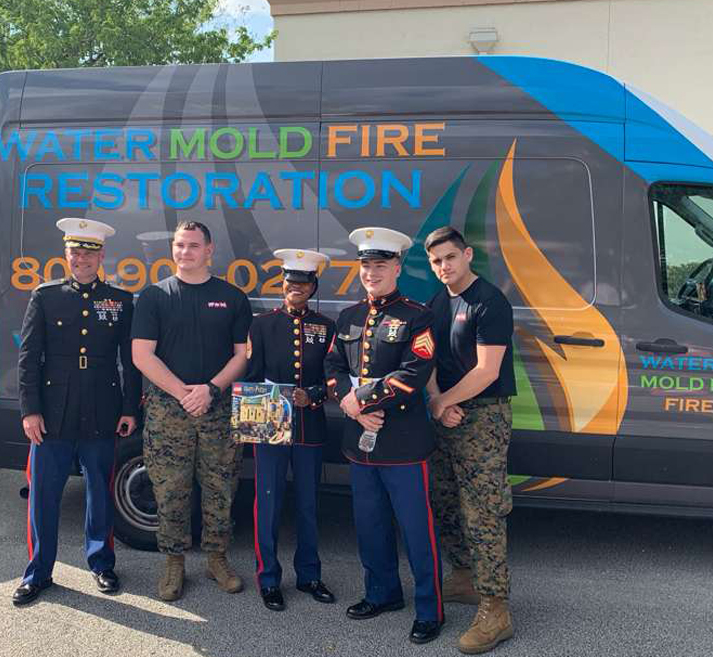
 Community & Military Support