IICRC S520 Mold Removal & Remediation in Chicago
Mold in Chicago is not driven by Sun Belt humidity, but it is no less common. The drivers are different: damp basements with clay-soil water tables, frozen pipe bursts that soak drywall for days while owners are out of town, summer sewer backups pushing Category 3 water through finished basements and garden units, ice dam meltwater seeping into top-floor ceilings, chronic supply line pinholes in century-old galvanized plumbing in Lakeview two-flats and Logan Square greystones, and the sealed-tight new-construction lakefront condos where any moisture event has nowhere to dry out to. Water Mold Fire Restoration of Chicago is IICRC Firm Certified and performs mold remediation in accordance with the IICRC S520 Standard for Professional Mold Remediation — the published industry consensus standard recognized by insurance carriers, IAQ professionals and the courts. Reconstruction stays in-house under our Chicago General Contractor License #TGC141820.
Why Chicago Properties Develop Mold
Mold calls across Cook County and Chicagoland trace back to a handful of conditions specific to this market. We see the same patterns repeat in Chicago bungalows, two-flats and three-flats, greystones, lakefront high-rises, postwar ranches and pre-WWII apartment conversions:
- Damp basements & garden units. Chicago's high water table and clay soils keep basements at elevated moisture levels year-round. Field-stone foundations in vintage bungalows wick groundwater through the parge coat; poured concrete foundations crack at the cold joint; block foundations leak at the mortar lines. Finished basements without continuous dehumidification, basement bedrooms in garden-unit conversions, and storage rooms in two-flat and three-flat buildings all accumulate moisture and produce visible mold within months.
- Post-frozen-pipe-burst contamination. Polar vortex events in January 2014, January 2019 and January 2024 each produced citywide waves of frozen pipe bursts. When the burst happens while owners are out of town, drywall and framing can sit saturated for days before discovery. Mold colonizes within 48 hours. The post-burst mold catch-up work runs for months after every major cold snap.
- Post-sewer-backup contamination. Sewer backups deposit Category 3 contaminated water across basement floors and into drywall, framing, insulation, carpet and cabinetry. Even with prompt extraction, residual biofilm and moisture seed aggressive mold colonization. The July 2023 Lower West Side and July 2024 Northwest Side flooding events drove a wave of post-backup remediation work across the affected neighborhoods.
- Ice dam attic mold. Meltwater backed up behind eave ice dams enters attic insulation and roof sheathing, often invisibly. Owners discover the mold months later during a roof project or listing inspection. Attic mold from ice dam intrusion is a recurring Chicago category we don't see in Sun Belt markets.
- Original-era plumbing failures. Chicago's pre-WWII housing stock — bungalows, two-flats and three-flats, greystones, workers' cottages — runs on galvanized supply pipe (pinholing after 60-80 years) and cast-iron drain stacks (rusting through at hub joints). Slow chronic leaks behind tiled walls, under sinks and inside cabinets seed mold colonies that compound over months before anyone smells the problem.
- Two-flat & condo cross-unit migration. Chicago's two-flat, three-flat and 6-flat building stock, plus the lakefront high-rise condo inventory, all share plumbing risers, HVAC, common drain stacks and party walls. A leak in the upstairs unit produces mold in the unit below, and HOA-versus-owner responsibility disputes routinely complicate remediation timing. We work multi-unit jobs regularly.
- Sealed-tight new construction. Modern energy-code construction in West Loop, Fulton Market and the newer lakefront condo towers achieves tight envelope performance — which also means any moisture event has nowhere to dry out to without mechanical assistance. Small leaks become outsize mold problems faster in tight construction than in vintage drafty stock.
Credentials, Standards & What They Mean in Illinois
Illinois does not license mold assessment or mold remediation contractors at the state level, unlike Florida (Chapter 468), Texas, New York and a handful of other states. The Illinois Department of Public Health publishes consumer guidance on mold, but no individual or company license is required to perform the work. That puts the burden on Chicago property owners to evaluate restoration companies on the credentials that actually substantiate the work.
The meaningful credentials are industry certification and adherence to the published consensus standards:
- IICRC Firm Certified. Firm-level certification from the Institute of Inspection, Cleaning and Restoration Certification — the recognized standards body for water damage restoration (IICRC S500), mold remediation (IICRC S520) and fire and smoke damage restoration (IICRC S700). Firm certification means the company itself operates under IICRC standards, not just individual technicians holding cards.
- IICRC S520 Standard for Professional Mold Remediation. The published ANSI-process industry consensus standard for how mold remediation must be performed: containment design, negative-air pressure and HEPA filtration requirements, personal protective equipment, porous-material removal protocols, antimicrobial use, and documentation expected for post-remediation clearance. We work to S520 on every job.
- Licensed Chicago General Contractor #TGC141820. Issued by the City of Chicago Department of Buildings. Required for any general contracting work within Chicago city limits — meaning reconstruction after a mold remediation (drywall replacement, finish carpentry, flooring, sometimes electrical and plumbing rough-in) stays in-house and properly permitted, not subbed out to unlicensed labor.
- Independent post-remediation verification. The EPA, IICRC and ASTM all recommend independent third-party post-remediation verification on significant jobs. Illinois doesn't require it, but we recommend it on insurance-driven and large-scope work to remove any conflict of interest from the final clearance decision. We perform our own mold inspection and testing service for smaller jobs and coordinate with independent IAQ assessors when independence is warranted.
Our Mold Remediation Process (IICRC S520)
- On-site assessment. Visual inspection, moisture mapping, thermal imaging, identification of the moisture source.
- Containment setup. 6-mil polyethylene barriers, sealed HVAC vents, negative air pressure with HEPA scrubbers exhausted outside containment.
- Personal protective equipment. Tyvek suits, gloves, eye protection, N95 or half-face HEPA respirators.
- Removal of contaminated porous materials. Drywall, insulation, carpet, pad, baseboards, cabinetry, bagged inside containment and removed through a decontamination route.
- HEPA filtration & surface cleaning with EPA-registered antimicrobials.
- Moisture source repair. Plumbing, foundation seal, HVAC, sump pump replacement, basement waterproofing — whatever the source actually is, fixed as part of the same job.
- Post-remediation clearance. Visual verification and, on significant jobs, independent third-party post-remediation verification (PRV).
- Reconstruction. Drywall, flooring, cabinetry, paint and finish carpentry — in-house under Chicago General Contractor License #TGC141820, properly permitted through the Department of Buildings.
Types of Mold We Remediate in Chicago
Common indoor molds we encounter on Cook County jobs include Stachybotrys chartarum ("black mold"), Aspergillus, Penicillium, Cladosporium and Chaetomium. The EPA, CDC and IICRC treat any indoor mold growth as a problem regardless of species, and the S520 protocol is essentially the same across genera. Species identification is the assessor's job; we work from the assessor's protocol (or, on small unassessed jobs, from our own visual and instrument-based scope).
Where We Remediate Mold in Chicago & Chicagoland
Lakeview, Wrigleyville, Boystown, Lincoln Park, Old Town, Gold Coast, Streeterville, River North, the Loop, West Loop, Fulton Market, South Loop, Pilsen, Bridgeport, Hyde Park, Kenwood, Bronzeville, Beverly, Logan Square, Wicker Park, Bucktown, Humboldt Park, Avondale, Lincoln Square, Andersonville, Edgewater, Uptown, Rogers Park, North Center, Roscoe Village, Irving Park, Albany Park, Portage Park, Jefferson Park, the bungalow belt, and suburban Evanston, Skokie, Wilmette, Glenview, Northbrook, Park Ridge, Arlington Heights, Schaumburg, Naperville, Oak Park, Berwyn and Cicero.
Chicago Mold Remediation FAQs
No. Illinois does not require state licensure for mold remediation or assessment, unlike Florida. The meaningful credentials are IICRC Firm certification, adherence to the IICRC S520 standard, and proper municipal contractor licensing (in our case, Chicago General Contractor License #TGC141820).
Damp basements with clay-soil water tables, frozen pipe bursts, sewer backups, ice dam meltwater, original galvanized plumbing pinholes, and sealed-tight new construction that can't dry out. Chicago's drivers are different from Sun Belt markets but no less common.
Not legally — Illinois doesn't license either side. But EPA/IICRC/ASTM recommend independent assessment before significant remediation, and many insurance carriers require it on larger jobs. The EPA recommends professional remediation for any mold affecting more than 10 sq ft.
IICRC S520 — the published ANSI-process consensus standard for mold remediation. We are IICRC Firm Certified, meaning the firm operates under IICRC standards across all three relevant standards (S500 water, S520 mold, S700 fire).
Small contained basement jobs run a few hundred dollars; large losses involving HVAC contamination, two-flat cross-unit work or whole-property post-sewer-backup remediation can run into the thousands. Written estimates after on-site evaluation.
Small contained jobs: 1-3 days. Larger jobs: 3-7 days plus reconstruction. Reconstruction handled in-house under Chicago GC License #TGC141820.
EPA, CDC and IICRC treat indoor mold growth as a problem regardless of species — the same remediation protocol applies. For health-driven questions, consult a physician; we are not medical providers.
Call Chicago's IICRC-Certified Mold Remediation Team
Water Mold Fire Restoration of Chicago3521 North Wilton Avenue
Chicago, IL 60657
312-574-3814 · chicago@watermoldfire.net
IICRC Firm Certified · Chicago GC License #TGC141820
Visible growth, musty basement smell, recent frozen pipe burst, sewer backup or ice dam intrusion? Call 312-574-3814 and we'll schedule an on-site evaluation.
← Back to all Chicago restoration services
 IICRC Certified Firm
 Satisfaction Guaranteed!
 24/7 Emergency Service
 Expert Technicians
 Direct Insurance Billing
 Unsurpassed Customer Service
 No Damage We Can’t Manage!
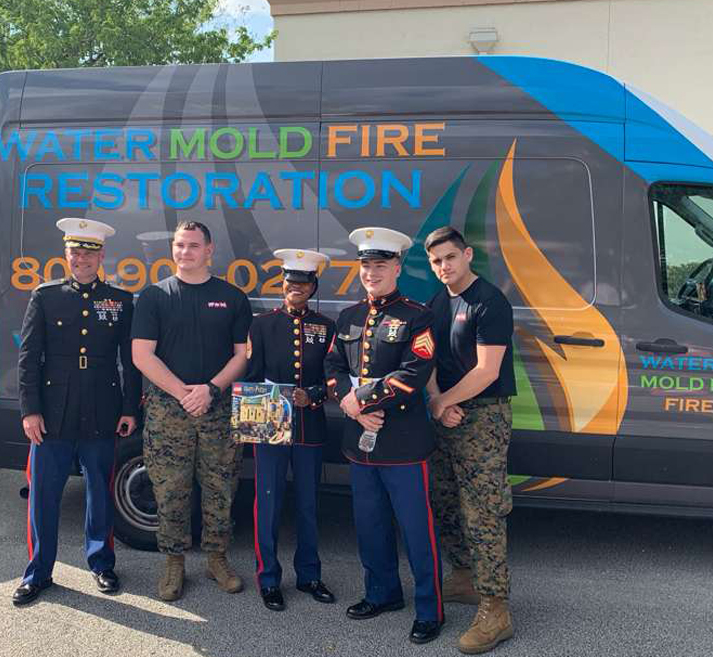
 Community & Military Support