Mold Inspection & Testing in Washington DC
Washington, DC does not license mold assessment professionals at the District level — unlike Florida (which licenses both assessors and remediators under Chapter 468 of the Florida Statutes), Texas, New York and a handful of other states. That means DC property owners evaluating an assessment quote have to weigh credentials that actually substantiate the work: industry certification, use of AIHA-accredited laboratories for sample analysis, and adherence to published assessment standards (ASTM and IICRC). Water Mold Fire Restoration of Washington DC is IICRC Firm Certified, performs assessments to ASTM and IICRC documentation standards, and uses AIHA-accredited labs for all sample analysis. We perform inspections and testing for real estate transactions, post-sewer-backup losses, English basement and crawlspace indoor air quality concerns, rowhouse party-wall and condo HOA disputes, embassy-row historic property assessments, insurance claims and post-remediation verification across all four quadrants of the District and the surrounding DMV.
When DC Properties Need a Mold Inspection
In a city with English basements as a near-universal feature, housing stock that runs back to the 1820s, humid subtropical summers and a combined sewer infrastructure that produces predictable basement backups, "I want to know what's actually in this property" is one of the most reasonable things a DC property owner or buyer can ask. The most common scenarios:
- Pre-purchase real estate inspections. DC's housing inventory — Federal-era and Victorian rowhouses on Capitol Hill, in Logan Circle and Shaw, Wardman rowhouses across Petworth and Park View, Adams Morgan and Mount Pleasant Victorians, Foggy Bottom and West End condos, Cleveland Park and Woodley Park 1920s-30s apartment houses, Georgetown Federals, embassy-row mansions, and new condo towers in NoMa and Capitol Riverfront — carries hidden-mold profiles that standard home inspections will not surface. Most DC home inspectors do not perform air sampling and are limited to visual checks and moisture meter readings. An independent mold assessment tells you what's actually behind the drywall, in the English basement, in the attic and in the HVAC system before you close.
- English basement & garden unit assessments. DC's signature below-grade rowhouse space is also its most consistent hidden-moisture environment. English basements sit below sewer-line elevation and accumulate moisture from groundwater seepage, summer sewer backups, A/C condensate and upstairs plumbing failures. Pre-purchase and pre-rental assessments confirm whether visible finish is hiding a moisture problem behind it.
- Post-sewer-backup assessments. Sewer backup water is Category 3 ("black water") under published industry standards and seeds aggressive mold colonization even after prompt cleanup. After the July 8, 2019 Northwest DC flash flooding and the recurring smaller backup events through every summer storm season, post-backup mold assessment work runs for months in the affected basements.
- Rowhouse party-wall disputes. DC's rowhouse density produces recurring disputes between neighbors over which side of a shared party wall the moisture is originating from and which owner is responsible for the resulting mold. Independent neutral assessment with moisture mapping, thermal imaging and lab results gives both parties a defensible basis for the responsibility decision.
- Condo HOA disputes. Foggy Bottom, West End, Dupont, downtown, NoMa, Capitol Riverfront and Southwest Wharf condos share HVAC stacks, plumbing risers and common chases that move moisture between units. Independent assessment is usually the fastest path through condo-board-versus-unit-owner stalemates over remediation responsibility.
- Historic district assessments. Capitol Hill Historic District, Georgetown Historic District, Massachusetts Avenue Historic District, U Street Historic District, Logan Circle Historic District, Mount Pleasant Historic District and Sheridan-Kalorama Historic District all have properties where envelope modifications require DC Historic Preservation Office review. Assessment documentation must support the HPO process when envelope-affecting remediation work is anticipated.
- Indoor air quality (IAQ) testing. Unexplained respiratory symptoms, persistent musty smell in an English basement, new-occupant complaints in a rental garden unit, or due-diligence baseline testing for a buyer with allergy or asthma concerns. We perform IAQ-focused sampling protocols beyond the standard mold scope when warranted.
- Insurance claim documentation. DC and DMV insurance carriers increasingly require independent mold assessment documentation on water claims of significant size before closing them out. Our reports are written to meet that standard.
- Post-Remediation Verification (PRV). Independent verification that a completed mold remediation actually worked. EPA, IICRC and ASTM all recommend PRV by an independent third party on significant jobs.
DC Mold Regulation & Why Independence Still Matters
Washington, DC does not license mold assessment or mold remediation contractors. The DC Department of Health publishes consumer guidance documents on indoor mold, but no individual or company license is required to perform either service. This is different from Florida, where Chapter 468, Part XVI of the Florida Statutes requires separate Mold Assessor and Mold Remediator licenses and prohibits the same company from doing both on the same project.
DC doesn't impose that separation by law, but the published industry consensus — the EPA's Mold Remediation in Schools and Commercial Buildings guidance, the IICRC industry standards for mold remediation and assessment, and the ASTM standards for moisture and mold assessment — all recommend that mold assessment and mold remediation be performed by independent parties on significant jobs. The reasoning is the same in DC as it is in Florida: an assessor who is also bidding the remediation contract has an incentive to oversize the findings, and a remediator performing its own clearance has an incentive to undersize them.
We follow that best practice voluntarily. We perform our own mold remediation service in DC (a legal scope here), and we perform assessment and testing on the same property when warranted. For insurance-driven and large-scope jobs, we recommend independent third-party post-remediation verification — and we can coordinate with independent indoor air quality assessors when that separation matters to the claim or to the parties involved.
Our Mold Inspection & Testing Process
- Pre-inspection consult. Reason for assessment, property history, recent water events (sewer backup, English basement flood, frozen pipe burst, hurricane remnant intrusion), occupant health concerns.
- On-site visual inspection. Systematic walkthrough with photo documentation. English basement, mechanical rooms, kitchen and bathroom plumbing chases, attic, party walls, HVAC closets and supply runs.
- Moisture mapping & thermal imaging. Calibrated meters and thermographic camera locate hidden moisture in walls, ceilings, floor cavities, brick foundations and around plumbing penetrations.
- Air sampling (spore trap). Outdoor baseline + indoor samples for lab comparison.
- Surface sampling. Tape lifts, swabs, bulk samples for direct identification.
- AIHA-accredited lab analysis. Standard 3-5 business days; rush 24-48 hours.
- Written assessment report. Photos, moisture mapping, thermal images, lab results, interpretation, and (where mold is confirmed) a recommended remediation scope.
Types of Testing We Perform
- Air sampling (spore trap). Indoor vs. outdoor airborne spore comparison.
- Surface sampling. Species ID via tape lift, swab, settled dust.
- Bulk sampling. Direct examination of suspect materials.
- HVAC sampling. Air handler and duct sampling for system contamination — particularly relevant in DC's long humid cooling season.
- English basement & crawlspace sampling. DC rowhouses, garden units and pre-WWII single-family stock with damp foundations.
- Attic sampling. Hurricane remnant and roof-leak-driven attic mold detection in older DC and DMV housing.
- Indoor Air Quality (IAQ) testing. Broader sampling for occupant health concerns.
- Post-Remediation Verification. Independent verification against the original remediation scope.
Where We Inspect & Test in DC & the DMV
All four quadrants of the District — Foggy Bottom, West End, Georgetown, Glover Park, Palisades, Spring Valley, Tenleytown, Friendship Heights, Cleveland Park, Woodley Park, Kalorama, Dupont, Logan Circle, U Street, Shaw, Penn Quarter, Downtown, Adams Morgan, Mount Pleasant, Columbia Heights, Petworth, Park View, Brookland, Eckington, NoMa, H Street, Capitol Hill, Navy Yard, Capitol Riverfront, Anacostia, Congress Heights, Southwest Waterfront, the Wharf. Northern Virginia: Arlington, Rosslyn, Clarendon, Ballston, Crystal City, Alexandria, Old Town, Del Ray, McLean, Falls Church, Vienna, Tysons. Suburban Maryland: Bethesda, Chevy Chase MD, Silver Spring, Takoma Park, College Park, Hyattsville, Rockville. Real estate closings and insurance deadlines often run tight — we schedule rush appointments where the calendar allows.
DC Mold Inspection & Testing FAQs
No. DC does not require District-level licensure for mold assessment or remediation. The meaningful credentials are IICRC Firm certification, adherence to ASTM and IICRC assessment standards, and use of AIHA-accredited laboratories.
Strongly recommended for any rowhouse with an English basement, any pre-WWII brick rowhouse, and any property in a historic district. Standard DC home inspections typically do not include air sampling. English basement and party-wall moisture profiles are not visible from the showing walkthrough.
Inspection is visual/instrument-based; testing is lab analysis of samples collected during inspection. Most DC assessments include both.
EPA, IICRC and ASTM all recommend independent third-party PRV on significant jobs — even though DC doesn't require it (Florida does). Conflict-of-interest removal: an assessor bidding the remediation has incentive to oversize; a remediator self-clearing has incentive to undersize.
Yes. Sewer backup water is Category 3 and seeds mold colonization even after prompt cleanup. The July 8, 2019 flash flooding is the most visible recent example, but smaller backups happen every summer storm season. Independent assessment confirms drying succeeded and mold did not colonize.
Yes — recurring DC category. Rowhouse party-wall disputes and condo HOA cross-unit disputes both benefit from independent neutral documentation that gives all parties a defensible basis for the responsibility decision.
Yes. Capitol Hill, Georgetown, Massachusetts Avenue, U Street, Logan Circle, Mount Pleasant, Sheridan-Kalorama and the District's other historic-district properties all have moisture and remediation considerations that benefit from detailed documentation supporting any anticipated DC Historic Preservation Office review.
Standard single-family / condo inspection with 2-3 air samples runs low hundreds; larger properties and building-wide scopes cost more. Written quote before sampling.
On-site 1-3 hours. Lab analysis 3-5 business days standard, 24-48 hours rush available.
Schedule a DC Mold Inspection
Water Mold Fire Restoration of Washington DC2200 Pennsylvania Avenue NW
Washington, DC 20037
202-650-0299 · washingtondc@watermoldfire.net
IICRC Firm Certified
Real estate closing, post-sewer-backup assessment, English basement IAQ concern, rowhouse party-wall dispute or condo HOA dispute? Call 202-650-0299 to schedule.
← Back to all Washington DC restoration services
 IICRC Certified Firm
 Satisfaction Guaranteed!
 24/7 Emergency Service
 Expert Technicians
 Direct Insurance Billing
 Unsurpassed Customer Service
 No Damage We Can’t Manage!
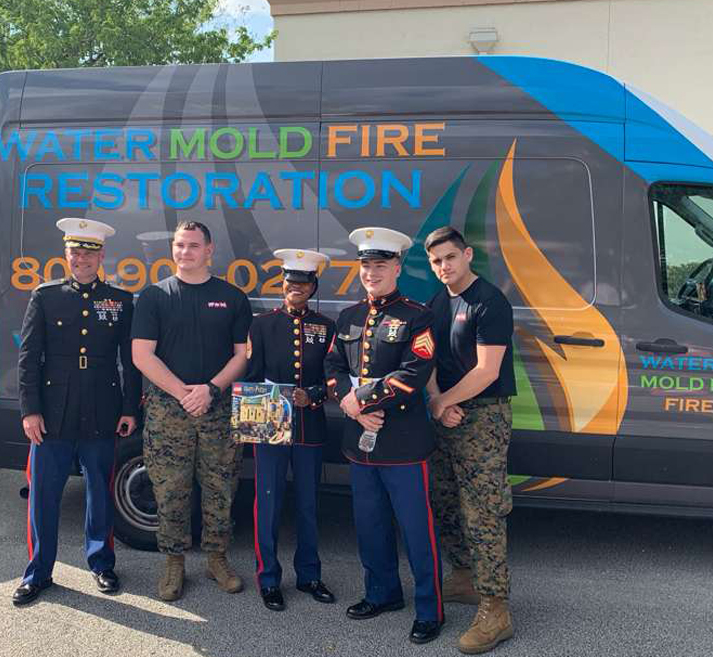
 Community & Military Support