Industry-Standard Mold Removal & Remediation in Washington DC
Mold in Washington DC is a year-round condition driven by the city's humid subtropical climate, its 19th-century combined sewer infrastructure, and a residential building stock dominated by century-old brick rowhouses with below-grade English basements. With July and August outdoor relative humidity routinely above 70-75%, summer thunderstorm sewer backups that deposit Category 3 contaminated water in English basements, an A/C cooling season that runs from May through October producing constant condensate, and a Federal Triangle's worth of pre-WWII brick rowhouses still running on original galvanized supply pipe, DC gives mold every condition it needs to colonize. Water Mold Fire Restoration of Washington DC is IICRC Firm Certified and performs mold remediation in accordance with the published industry consensus standard (the IICRC S520 Standard for Professional Mold Remediation) recognized by insurance carriers, indoor air quality professionals and the courts.
Why DC Properties Develop Mold
Mold calls across all four quadrants of the District and the surrounding DMV trace back to a handful of conditions specific to this market. We see the same patterns repeat in Capitol Hill rowhouses, Georgetown Federals, Adams Morgan and Mount Pleasant Victorians, Petworth and Park View Wardmans, Foggy Bottom and West End condos, Cleveland Park and Woodley Park apartment houses, and the modern towers of NoMa, Capitol Riverfront and the Southwest Wharf:
- English basement & garden unit moisture. DC's signature below-grade rowhouse space is also its most consistent mold environment. English basements sit below sewer-line elevation, accumulate groundwater seepage through brick foundations, take Category 3 contamination during summer sewer backups, and trap A/C condensate and HVAC moisture. Finished English basements with drywall, carpet, cabinetry and sometimes full kitchens produce significant remediation scopes; the moisture problem usually predates the visible mold discovery by months or years.
- Post-sewer-backup contamination. DC's combined sewer system in older neighborhoods deposits Category 3 contaminated water across basement floors during heavy summer thunderstorm events. Even with prompt extraction, residual biofilm and moisture seed aggressive mold colonization. The July 8, 2019 Northwest DC flash flooding produced months of post-backup remediation work across the affected English basements.
- Summer humidity & A/C condensate. DC's humid subtropical climate keeps outdoor relative humidity above 70% through the cooling season. A/C systems carry heavy condensate loads from May through October, and any clogged drain line, undersized return or short-cycling oversized unit produces persistent moisture inside the air handler and supply plenum. Air handlers are mold incubators in this climate, and contamination of the air-distribution system spreads spores building-wide before anyone notices.
- Hurricane remnant water intrusion. Wind-driven rain from hurricane remnants and tropical storms moving up the mid-Atlantic pushes water through roof-to-wall transitions, around window frames, under entry thresholds and into attic spaces. Hurricane Isabel (2003), Hurricane Sandy remnants (2012), Hurricane Florence remnants (2018) and every active Atlantic season since leaves DC properties with envelope-driven moisture that seeds mold within 48 hours.
- Rowhouse party-wall moisture migration. DC's rowhouse density — Capitol Hill, Logan Circle, Shaw, U Street, Adams Morgan, Mount Pleasant, Petworth, Park View, Bloomingdale, Eckington, Brookland, H Street, Georgetown — means a leak in one party-wall cavity can produce visible mold in the neighbor's interior days later. Shared chimney chases and common plumbing stacks compound the cross-house exposure.
- Original-era plumbing failures. DC's pre-WWII housing stock — Federal-era Capitol Hill, Victorian Logan Circle, turn-of-century Adams Morgan and Mount Pleasant, Wardman rowhouses in Petworth and Park View — still carries galvanized supply pipe (pinholing from the inside out after 60-80 years) and cast-iron drain stacks (rusting through at hub joints). Slow chronic leaks behind tiled walls, under sinks and inside cabinets seed mold colonies that compound over months.
- Condo cross-unit migration. Foggy Bottom, the West End, Dupont, Logan, downtown, NoMa, Capitol Riverfront, the Southwest Wharf and the modern Rosslyn and Crystal City towers all share HVAC stacks, common drain risers and pressurized air-distribution systems that move spores between units. A single unit with hidden moisture can seed colonization across the floor above and below.
- Historic-district envelope constraints. Capitol Hill, Georgetown, Massachusetts Avenue, U Street and other DC historic districts restrict envelope modifications on contributing properties. Remediation that requires opening exterior brick or replacing original windows triggers Historic Preservation Office review. We coordinate that process where it applies.
Credentials, Standards & What They Mean in DC
Washington, DC does not license mold assessment or mold remediation contractors at the District level, unlike Florida (which licenses both under Chapter 468 of the Florida Statutes), Texas, New York and a handful of other states. The DC Department of Health publishes consumer guidance on indoor mold, but no individual or company license is required to perform the work. That puts the burden on DC property owners to evaluate restoration companies on the credentials that actually substantiate the work.
The meaningful credentials are industry certification and adherence to the published consensus standards:
- IICRC Firm Certified. Firm-level certification from the Institute of Inspection, Cleaning and Restoration Certification — the recognized standards body for water damage restoration, mold remediation and fire and smoke damage restoration. Firm certification means the company itself operates under IICRC standards, not just individual technicians holding cards.
- Published industry consensus standard. We work to the IICRC S520 Standard for Professional Mold Remediation on every job — the ANSI-process industry consensus standard specifying containment design, negative-air pressure and HEPA filtration requirements, personal protective equipment, porous-material removal protocols, antimicrobial use, and the documentation expected for post-remediation clearance.
- Independent post-remediation verification. The EPA, IICRC and ASTM all recommend independent third-party post-remediation verification on significant jobs. DC doesn't require it, but we recommend it on insurance-driven and large-scope work to remove any conflict of interest from the final clearance decision. We perform our own mold inspection and testing service for smaller jobs and coordinate with independent IAQ assessors when independence is warranted.
Our Mold Remediation Process
Every job we run follows the IICRC S520 Standard for Professional Mold Remediation:
- On-site assessment. Visual inspection, moisture mapping, thermal imaging, identification of the moisture source (sewer backup, English basement seepage, A/C condensate, party-wall migration, original plumbing failure, hurricane remnant intrusion).
- Containment setup. 6-mil polyethylene barriers, sealed HVAC vents, negative air pressure with HEPA scrubbers exhausted outside containment.
- Personal protective equipment. Tyvek suits, gloves, eye protection, N95 or half-face HEPA respirators.
- Removal of contaminated porous materials. Drywall, insulation, carpet, pad, baseboards, cabinetry, bagged inside containment and removed through a decontamination route.
- HEPA filtration & surface cleaning with EPA-registered antimicrobials.
- Moisture source repair. Plumbing, foundation seal, HVAC, sump pump installation or replacement, basement waterproofing — whatever the source actually is, fixed as part of the same job.
- Post-remediation clearance. Visual verification and, on significant jobs, independent third-party post-remediation verification (PRV).
- Reconstruction. Drywall, flooring, cabinetry, paint and finish carpentry, coordinated with licensed DC trade subcontractors and properly permitted through the DC Department of Buildings, with Historic Preservation Office coordination on historic-district properties.
Types of Mold We Remediate in DC
Common indoor molds we encounter on DC area jobs include Stachybotrys chartarum ("black mold"), Aspergillus, Penicillium, Cladosporium and Chaetomium. The EPA, CDC and IICRC treat any indoor mold growth as a problem regardless of species, and the remediation protocol is essentially the same across genera. Species identification is the assessor's job; we work from the assessor's protocol or, on small unassessed jobs, from our own visual and instrument-based scope.
Where We Remediate Mold in DC & the DMV
All four quadrants of the District — Foggy Bottom, West End, Georgetown, Glover Park, Palisades, Spring Valley, Tenleytown, Friendship Heights, Cleveland Park, Woodley Park, Kalorama, Dupont, Logan Circle, U Street, Shaw, Penn Quarter, Downtown, Adams Morgan, Mount Pleasant, Columbia Heights, Petworth, Park View, Brookland, Eckington, NoMa, H Street, Capitol Hill, Navy Yard, Capitol Riverfront, Anacostia, Congress Heights, Southwest Waterfront, the Wharf. Northern Virginia: Arlington, Rosslyn, Clarendon, Ballston, Crystal City, Alexandria, Old Town, Del Ray, McLean, Falls Church, Vienna, Tysons. Suburban Maryland: Bethesda, Chevy Chase MD, Silver Spring, Takoma Park, College Park, Hyattsville, Rockville.
DC Mold Remediation FAQs
No. DC does not require District-level licensure for mold remediation or assessment, unlike Florida. The meaningful credentials are IICRC Firm certification and adherence to the published industry consensus standards.
Humid subtropical summers (70-75% RH), combined sewer backups depositing Category 3 water in English basements, chronic basement moisture from elevated water tables, A/C condensate during the long cooling season, hurricane remnant water intrusion, rowhouse party-wall migration, and original galvanized plumbing pinholes in pre-WWII stock. DC drivers are humid-summer + below-grade-basement specific.
Not legally — DC doesn't license either side. But EPA/IICRC/ASTM recommend independent assessment before significant remediation, and many insurance carriers require it on larger jobs. EPA recommends professional remediation for any mold affecting more than 10 sq ft.
The IICRC S520 industry consensus standard. We are IICRC Firm Certified.
Yes — one of our most consistent DC scopes. English basements sit below sewer-line elevation and accumulate moisture from groundwater seepage, summer sewer backups, A/C condensate and upstairs plumbing failures. Finished English basements with kitchens and baths produce significant remediation scopes.
Yes. Foggy Bottom, West End, Dupont, downtown, NoMa, Capitol Riverfront and the Southwest Wharf condos all have cross-unit migration paths. Historic-district properties (Capitol Hill, Georgetown, Massachusetts Avenue, U Street) require DC Historic Preservation Office coordination for envelope-affecting work.
Small contained jobs run a few hundred dollars; large losses involving HVAC contamination, full English basement remediation or condo cross-unit work can run into the thousands. Written estimates after on-site evaluation.
Small contained jobs: 1-3 days. Larger jobs: 3-7 days plus reconstruction.
Call DC's IICRC-Certified Mold Remediation Team
Water Mold Fire Restoration of Washington DC2200 Pennsylvania Avenue NW
Washington, DC 20037
202-650-0299 · washingtondc@watermoldfire.net
IICRC Firm Certified
Visible growth, musty English basement smell, recent sewer backup, A/C condensate stain or hurricane remnant intrusion? Call 202-650-0299 and we'll schedule an on-site evaluation.
← Back to all Washington DC restoration services
 IICRC Certified Firm
 Satisfaction Guaranteed!
 24/7 Emergency Service
 Expert Technicians
 Direct Insurance Billing
 Unsurpassed Customer Service
 No Damage We Can’t Manage!
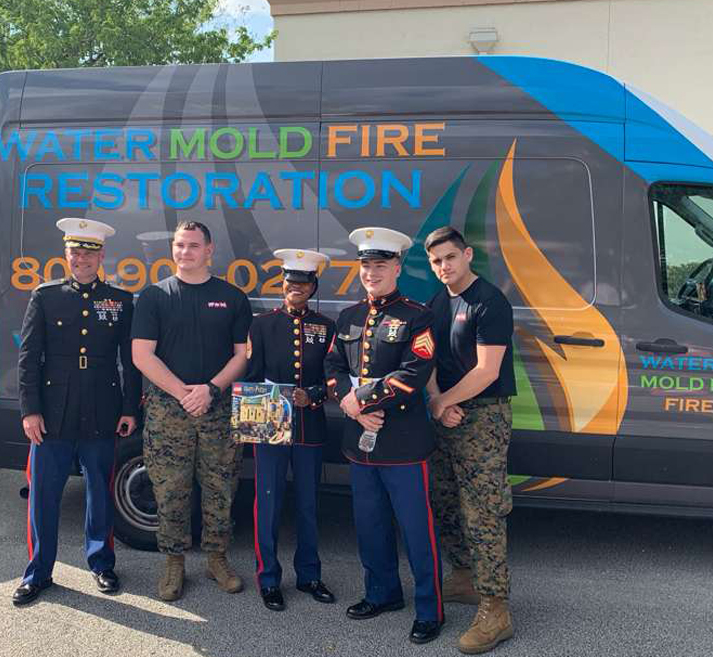
 Community & Military Support