Industry-Standard Mold Removal & Remediation in Albuquerque
The most consequential mold-related belief in the Albuquerque market is the assumption that high-desert homes don't get mold. They do. Ambient outdoor humidity in Albuquerque is low, but mold doesn't care about outdoor humidity — it cares about the moisture content of the material it's growing on. When a rooftop swamp cooler leaks into attic insulation, when a flat roof backs up during a monsoon storm, when wind-driven rain pushes through a stucco crack into a wall cavity, when a plumbing line fails behind a vanity, or when an arroyo overflow sends water into a ground-floor room, the affected materials reach the sustained moisture levels mold colonization requires regardless of what the air outside the house is doing. We see mold remediation work in ABQ homes every week of the year. Water Mold Fire Restoration of Albuquerque is IICRC Firm Certified and performs mold remediation in accordance with the published industry consensus standard (the IICRC S520 Standard for Professional Mold Remediation) recognized by insurance carriers, indoor air quality professionals and the courts.
Why Albuquerque Properties Develop Mold
Mold calls across the City of Albuquerque, Bernalillo County, Rio Rancho and the surrounding metro trace back to a handful of conditions specific to this high-desert market. We see the same patterns repeat across adobe and pueblo revival stock in the North Valley and Old Town, stucco-and-frame ranches in the Northeast Heights and Foothills, mid-century modern homes in Ridgecrest and Nob Hill, contemporary construction in Mesa del Sol and the Westside, mountainfront properties in Sandia Heights and Four Hills, and East Mountain properties out to Tijeras and Sandia Park:
- Swamp cooler (evaporative cooler) attic mold. ABQ's signature cooling technology is also its signature residential mold source. Swamp coolers sit on roofs; the water supply line, the float valve, the pads, the pump and the seasonal transitions all fail in predictable ways. A single failed swamp cooler can dump hundreds of gallons of water into attic insulation and ceiling cavities before anyone notices, and ABQ attics often go unobserved for months. The result is attic and ceiling-cavity mold on roof decking, framing and insulation. Spring startup (April-May) and fall shutdown (October-November) are peak windows for the failures that produce the work.
- Post-monsoon stucco-cavity moisture. Wind-driven monsoon rain pushes water through hairline stucco cracks at corners, window heads, door frames and parapet caps. The water enters the wall cavity behind the stucco and stays there — sometimes for weeks — before producing visible interior damage. Stucco mesh and lath corrosion behind older stucco compounds the problem. ABQ homes from the 1950s through the 1980s with original stucco systems are particularly common candidates.
- Post-flat-roof-leak attic mold. Flat roofs with parapet drainage are an ABQ signature and a common leak source. Cottonwood debris, monsoon-blown dirt and bird nesting clog scuppers and internal drains; UV-cracked stucco-parapet flashings let water in; standing water during monsoon events finds membrane failures. Resulting attic and ceiling-cavity moisture seeds mold that often isn't visible from inside the house for weeks or months.
- Post-monsoon basement and crawlspace mold. Properties with basements (more common in older Huning Highland and Nob Hill stock and in some Northeast Heights homes) and crawlspaces (common in mid-century ABQ stock) take monsoon flash flood water that produces aggressive mold colonization if not dried within 48 hours. South Valley properties at lower elevation see the most exposure.
- Bathroom & kitchen mold. Poorly-vented bathroom exhaust fans trap shower moisture against ceiling drywall; chronic plumbing leaks under kitchen sinks seed cabinet-cavity mold; old fiberglass shower pans fail at the drain seal and produce wall-cavity moisture. ABQ's low ambient humidity doesn't protect any of these microenvironments because the moisture is coming from inside, not outside.
- HVAC & refrigerated air-handler mold. ABQ homes that have switched from swamp cooler to refrigerated air conditioning (a growing trend as electricity costs and water concerns shift the cost-benefit) have air handlers that produce condensate and can seed mold in plenums and ductwork when condensate drains clog or systems short-cycle. Older swamp cooler ductwork that's been re-used for refrigerated systems often holds residual mold from the swamp cooler era.
- Adobe & pueblo revival moisture migration. Adobe construction in the North Valley, Old Town, Corrales and the historic neighborhoods behaves differently when moisture intrudes. Solid adobe walls absorb and release moisture along long time constants; vigas and latillas hold moisture along grain patterns; flat-roof connections to thick exterior walls produce complex moisture migration paths. Remediation in these homes requires approaches that respect the original construction.
- Post-frozen-pipe-burst contamination. Polar-front cold snaps (the 2011 -15°F event being the recent benchmark) produce burst waves that, if undiscovered for hours or days, leave drywall and framing saturated. Mold colonizes within 48 hours regardless of low ambient humidity.
Credentials, Standards & What They Mean in New Mexico
New Mexico does not license mold assessment or mold remediation contractors at the state level, unlike Florida (which licenses both under Chapter 468 of the Florida Statutes), Texas, New York and a handful of other states. The New Mexico Environment Department publishes consumer guidance on indoor mold, but no individual or company license is required to perform the work. That puts the burden on New Mexico property owners to evaluate restoration companies on the credentials that actually substantiate the work.
The meaningful credentials are industry certification and adherence to the published consensus standards:
- IICRC Firm Certified. Firm-level certification from the Institute of Inspection, Cleaning and Restoration Certification — the recognized standards body for water damage restoration, mold remediation and fire and smoke damage restoration. Firm certification means the company itself operates under IICRC standards, not just individual technicians holding cards.
- Published industry consensus standard. We work to the IICRC S520 Standard for Professional Mold Remediation on every job — the ANSI-process industry consensus standard specifying containment design, negative-air pressure and HEPA filtration requirements, personal protective equipment, porous-material removal protocols, antimicrobial use, and the documentation expected for post-remediation clearance.
- Independent post-remediation verification. The EPA, IICRC and ASTM all recommend independent third-party post-remediation verification on significant jobs. New Mexico doesn't require it, but we recommend it on insurance-driven and large-scope work to remove any conflict of interest from the final clearance decision. We perform our own mold inspection and testing service for smaller jobs and coordinate with independent indoor air quality assessors when independence is warranted.
Our Mold Remediation Process
Every job we run follows the IICRC S520 Standard for Professional Mold Remediation:
- On-site assessment. Visual inspection, moisture mapping, thermal imaging, identification of the moisture source (swamp cooler leak, flat-roof failure, stucco-cavity intrusion, plumbing failure, monsoon flood aftermath, bathroom or kitchen leak, HVAC condensate).
- Containment setup. 6-mil polyethylene barriers, sealed HVAC vents, negative air pressure with HEPA scrubbers exhausted outside containment.
- Personal protective equipment. Tyvek suits, gloves, eye protection, N95 or half-face HEPA respirators.
- Removal of contaminated porous materials. Drywall, insulation, carpet, pad, baseboards, cabinetry, bagged inside containment and removed through a decontamination route.
- HEPA filtration & surface cleaning with EPA-registered antimicrobials.
- Moisture source repair. Swamp cooler service or replacement, flat-roof repair, stucco crack sealing, plumbing repair, foundation drainage, HVAC service — whatever the source actually is, fixed as part of the same job.
- Post-remediation clearance. Visual verification and, on significant jobs, independent third-party post-remediation verification (PRV).
- Reconstruction. Drywall, stucco patch, flooring, cabinetry, paint and finish carpentry, coordinated with licensed New Mexico trade subcontractors and properly permitted through the City of Albuquerque Planning Department or the relevant municipal building department.
Types of Mold We Remediate in Albuquerque
Common indoor molds we encounter on ABQ jobs include Stachybotrys chartarum ("black mold"), Aspergillus, Penicillium, Cladosporium and Chaetomium. The EPA, CDC and IICRC treat any indoor mold growth as a problem regardless of species, and the remediation protocol is essentially the same across genera. Species identification is the assessor's job; we work from the assessor's protocol or, on small unassessed jobs, from our own visual and instrument-based scope.
Where We Remediate Mold in Albuquerque & the Metro
The City of Albuquerque — Huning Highland, Downtown, EDo, Old Town, Sawmill District, Wells Park, Nob Hill, University Heights, Ridgecrest, Uptown, the Heights, Foothills, Far Northeast Heights, Glenwood Hills, Tanoan, Sandia Heights, Four Hills, Taylor Ranch, Paradise Hills, Volcano Cliffs, Westgate Heights, Ladera, Mesa Verde, Country Club, North Valley, Los Ranchos de Albuquerque, South Valley, International District, Mesa del Sol. Sandoval County: Rio Rancho, Corrales, Bernalillo, Placitas. East Mountains: Tijeras, Sandia Park, Cedar Crest, San Antonito, Edgewood, Moriarty. Valencia County: Los Lunas, Belen, Bosque Farms, Peralta.
Albuquerque Mold Remediation FAQs
Yes. The widespread ABQ belief that "we don't get mold because it's dry here" is wrong and consequential. Mold cares about the moisture content of the material it's growing on, not outdoor humidity. Swamp cooler leaks, flat-roof failures, stucco-cavity intrusion, plumbing leaks and monsoon flooding all reach the sustained material moisture mold colonization requires.
No. New Mexico does not require state licensure for mold remediation or assessment, unlike Florida. The meaningful credentials are IICRC Firm certification and adherence to the published industry consensus standards.
Swamp cooler attic leaks, flat-roof drainage failures, post-monsoon stucco-cavity intrusion, bathroom and kitchen plumbing leaks, and HVAC condensate. ABQ mold sources are uniquely regional.
Not legally — NM doesn't license either side. But EPA/IICRC/ASTM recommend independent assessment before significant remediation, and many insurance carriers require it on larger jobs. EPA recommends professional remediation for any mold affecting more than 10 sq ft.
The IICRC S520 industry consensus standard. We are IICRC Firm Certified.
Yes — one of our most consistent ABQ service categories. Failed swamp coolers dump water into attic insulation that ABQ owners can't see or hear from inside the house. Remediation requires full attic containment, contaminated insulation removal, HEPA cleaning, antimicrobial treatment and repair of the underlying swamp cooler failure.
Yes. Adobe, pueblo revival, territorial and Spanish colonial revival construction behaves differently from frame-and-stucco modern stock. North Valley, Country Club, Old Town, Corrales and Placitas adobe properties require approaches that respect the original construction and historic-preservation considerations where applicable.
Small contained jobs run a few hundred dollars; large losses involving full swamp cooler attic remediation, post-monsoon multi-room remediation or stucco-cavity work can run into the thousands. Written estimates after on-site evaluation.
Small contained jobs: 1-3 days. Larger jobs: 3-7 days plus reconstruction.
Call Albuquerque's IICRC-Certified Mold Remediation Team
Water Mold Fire Restoration of Albuquerque1925 Coal Place SE
Albuquerque, NM 87106
505-312-4758 · albuquerque@watermoldfire.net
IICRC Firm Certified
Visible growth, musty smell, swamp cooler leak that ran for days before discovery, post-monsoon ceiling stain, or stucco-cavity moisture concern? Call 505-312-4758 and we'll schedule an on-site evaluation.
← Back to all Albuquerque restoration services
 IICRC Certified Firm
 Satisfaction Guaranteed!
 24/7 Emergency Service
 Expert Technicians
 Direct Insurance Billing
 Unsurpassed Customer Service
 No Damage We Can’t Manage!
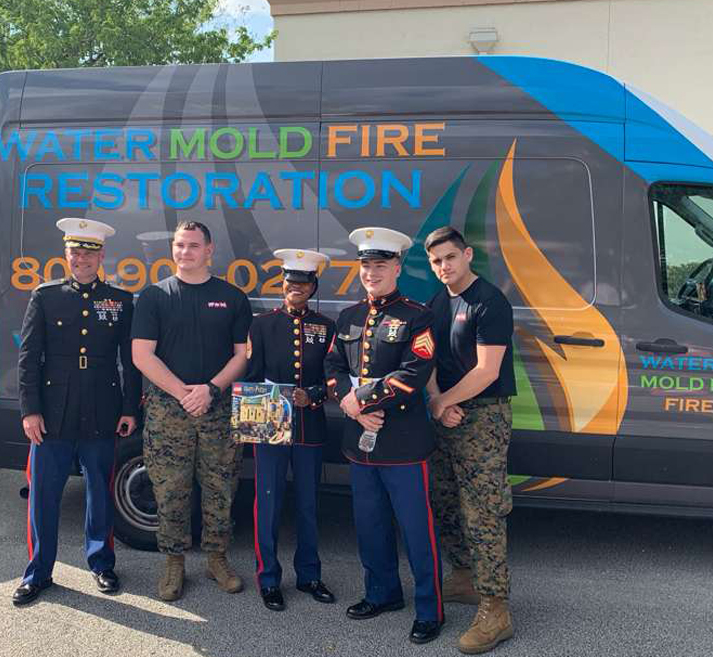
 Community & Military Support