Industry-Standard Mold Removal & Remediation in Minneapolis
Mold in Minneapolis is not driven by Sun Belt humidity, but it is no less common. The drivers are different: damp basements sitting over elevated Twin Cities water tables, frozen pipe bursts that soak drywall for days while owners are out of town, ice dam meltwater entering attic and ceiling cavities, spring snowmelt groundwater intrusion through foundation cracks, summer sewer backups pushing Category 3 water through finished basements, lake homes and cabins accumulating moisture during shoulder seasons, and chronic supply-line pinholes in century-old galvanized plumbing in Northeast Minneapolis duplexes and South Minneapolis bungalows. Water Mold Fire Restoration of Minneapolis is IICRC Firm Certified and performs mold remediation in accordance with the published industry consensus standard (the IICRC S520 Standard for Professional Mold Remediation) recognized by insurance carriers, indoor air quality professionals and the courts.
Why Twin Cities Properties Develop Mold
Mold calls across Minneapolis, Saint Paul and the inner-ring suburbs trace back to a handful of conditions specific to this market. We see the same patterns repeat in Northeast Minneapolis duplexes, South Minneapolis bungalows, American Foursquares, Mill District lofts, lake homes around Minnetonka and the western suburbs, and downtown high-rise condos:
- Damp basements & foundation moisture. Twin Cities clay soils and elevated water tables keep basements at high moisture levels year-round. Field-stone foundations in pre-WWII bungalows and duplexes wick groundwater through the parge coat; poured concrete foundations crack at the cold joint; block foundations leak at the mortar lines. Finished basements without continuous dehumidification, bedrooms in basement conversions, and storage rooms in duplex utility basements all accumulate moisture and produce visible mold within months.
- Post-frozen-pipe-burst contamination. Polar vortex events in January 2019, February 2021 and January 2024 each produced citywide waves of frozen pipe bursts. When the burst happens while owners are out of town for a cold snap or a snowbird trip, drywall and framing can sit saturated for days before discovery. Mold colonizes within 48 hours. The post-burst mold catch-up work runs for months after every major cold snap.
- Ice dam attic mold. Meltwater backed up behind eave ice dams enters attic insulation and roof sheathing, often invisibly. Owners discover the resulting mold months later during a roof project, a listing inspection, or when musty smell drives an investigation. Ice dam attic mold is a recurring Twin Cities category we don't see at the same volume in warmer-climate markets.
- Spring snowmelt & groundwater intrusion. Twin Cities winters routinely produce 50-70+ inches of snow. The spring thaw releases that water faster than still-frozen deep soils can absorb it, elevating the water table and pressuring foundation cracks. Slow groundwater intrusion into basements during March and April seeds aggressive mold colonization before owners realize the basement is wet.
- Post-sewer-backup contamination. Sewer backups deposit Category 3 contaminated water across basement floors and into drywall, framing, insulation, carpet and cabinetry. Even with prompt extraction, residual biofilm and moisture seed aggressive mold colonization.
- Lake home & cabin shoulder-season moisture. Properties around Lake Minnetonka, White Bear Lake, Forest Lake and the Brainerd Lakes corridor that sit unconditioned for weeks at a time accumulate moisture in walls, crawlspaces, three-season porches and HVAC systems faster than year-round residences. Frozen pipe bursts in winterized cabins that weren't properly drained add a second category we work routinely.
- Original-era plumbing failures. Pre-WWII Twin Cities housing — Northeast Minneapolis duplexes, South Minneapolis bungalows, Saint Paul Victorians, Highland Park and Macalester-Groveland single-family homes — runs on galvanized supply pipe (pinholing after 60-80 years) and cast-iron drain stacks (rusting through at hub joints). Slow chronic leaks behind tiled walls, under sinks and inside cabinets seed mold colonies that compound over months before anyone smells the problem.
- Mill District & North Loop conversions. The Mill District and North Loop loft conversions — century-old brick-and-timber flour and warehouse buildings retrofitted with modern plumbing — have particular exposure where retrofit work was rushed or where original masonry walls trap moisture from interior leaks.
Credentials, Standards & What They Mean in Minnesota
Minnesota does not license mold assessment or mold remediation contractors at the state level, unlike Florida (which licenses both under Chapter 468 of the Florida Statutes), Texas, New York and a handful of other states. The Minnesota Department of Health publishes consumer guidance on mold, but no individual or company license is required to perform the work. That puts the burden on Twin Cities property owners to evaluate restoration companies on the credentials that actually substantiate the work.
The meaningful credentials are industry certification and adherence to the published consensus standards:
- IICRC Firm Certified. Firm-level certification from the Institute of Inspection, Cleaning and Restoration Certification — the recognized standards body for water damage restoration, mold remediation and fire and smoke damage restoration. Firm certification means the company itself operates under IICRC standards, not just individual technicians holding cards.
- Published industry consensus standard. We work to the IICRC S520 Standard for Professional Mold Remediation on every job — the ANSI-process industry consensus standard specifying containment design, negative-air pressure and HEPA filtration requirements, personal protective equipment, porous-material removal protocols, antimicrobial use, and the documentation expected for post-remediation clearance.
- Independent post-remediation verification. The EPA, IICRC and ASTM all recommend independent third-party post-remediation verification on significant jobs. Minnesota doesn't require it, but we recommend it on insurance-driven and large-scope work to remove any conflict of interest from the final clearance decision. We perform our own mold inspection and testing service for smaller jobs and coordinate with independent IAQ assessors when independence is warranted.
Our Mold Remediation Process
Every job we run follows the IICRC S520 Standard for Professional Mold Remediation:
- On-site assessment. Visual inspection, moisture mapping, thermal imaging, identification of the moisture source (frozen pipe burst aftermath, ice dam intrusion, snowmelt groundwater, sewer backup, original plumbing failure, lake-home shoulder-season moisture).
- Containment setup. 6-mil polyethylene barriers, sealed HVAC vents, negative air pressure with HEPA scrubbers exhausted outside containment.
- Personal protective equipment. Tyvek suits, gloves, eye protection, N95 or half-face HEPA respirators.
- Removal of contaminated porous materials. Drywall, insulation, carpet, pad, baseboards, cabinetry, bagged inside containment and removed through a decontamination route.
- HEPA filtration & surface cleaning with EPA-registered antimicrobials.
- Moisture source repair. Plumbing, foundation seal, attic insulation and ventilation upgrades to prevent future ice dams, sump pump replacement, basement waterproofing — whatever the source actually is, fixed as part of the same job.
- Post-remediation clearance. Visual verification and, on significant jobs, independent third-party post-remediation verification (PRV).
- Reconstruction. Drywall, flooring, cabinetry, paint and finish carpentry, coordinated with licensed Twin Cities trade subcontractors and properly permitted through the relevant city building department.
Types of Mold We Remediate in the Twin Cities
Common indoor molds we encounter on Twin Cities jobs include Stachybotrys chartarum ("black mold"), Aspergillus, Penicillium, Cladosporium and Chaetomium. The EPA, CDC and IICRC treat any indoor mold growth as a problem regardless of species, and the remediation protocol is essentially the same across genera. Species identification is the assessor's job; we work from the assessor's protocol or, on small unassessed jobs, from our own visual and instrument-based scope.
Where We Remediate Mold in the Twin Cities
All of Minneapolis (Northeast, Downtown, North Loop, Mill District, Loring Park, Uptown, Whittier, Lyn-Lake, Powderhorn, Phillips, Cedar-Riverside, U of M area, Como, Prospect Park, Seward, Longfellow, Nokomis, Linden Hills, Lake Harriet, Bde Maka Ska, Kenwood, Lowry Hill, Bryn Mawr, Camden, Near North, Folwell, the bungalow belt). All of Saint Paul (Summit Hill, Macalester-Groveland, Highland Park, Crocus Hill, Como, Frogtown, Saint Anthony Park, Hamline-Midway, the East Side). Suburban Edina, Saint Louis Park, Bloomington, Eden Prairie, Minnetonka, Wayzata, Plymouth, Maple Grove, Brooklyn Park, Roseville, Richfield, Eagan, Burnsville, Apple Valley, Woodbury, and the lake communities around Lake Minnetonka, White Bear Lake and Forest Lake.
Minneapolis Mold Remediation FAQs
No. Minnesota does not require state licensure for mold remediation or assessment, unlike Florida. The meaningful credentials are IICRC Firm certification and adherence to the published industry consensus standards.
Damp basements with clay-soil water tables, frozen pipe bursts, ice dam meltwater, spring snowmelt groundwater, sewer backups, lake-home shoulder-season moisture and chronic galvanized-plumbing pinholes. Twin Cities drivers are different from Sun Belt markets but no less common.
Not legally — Minnesota doesn't license either side. But EPA/IICRC/ASTM recommend independent assessment before significant remediation, and many insurance carriers require it on larger jobs. EPA recommends professional remediation for any mold affecting more than 10 sq ft.
The IICRC S520 industry consensus standard. We are IICRC Firm Certified.
Yes — one of the most under-recognized mold sources in older Twin Cities housing. Meltwater backs up behind eave ice dams into attic insulation and roof sheathing, invisibly from inside. Discovered months later during roof work, listing inspections or when musty smell drives investigation.
Yes. Lake Minnetonka, White Bear Lake, Forest Lake, the Brainerd Lakes corridor. Unconditioned shoulder-season properties accumulate moisture faster than year-round residences. Winterized cabins with improperly drained plumbing add a frozen-pipe-burst mold category.
Small contained basement jobs run a few hundred dollars; large losses involving HVAC contamination, duplex cross-unit work, ice dam attic remediation or whole-property post-burst remediation can run into the thousands. Written estimates after on-site evaluation.
Small contained jobs: 1-3 days. Larger jobs: 3-7 days plus reconstruction.
Call Minneapolis's IICRC-Certified Mold Remediation Team
Water Mold Fire Restoration of Minneapolis1920 Central Avenue NE
Minneapolis, MN 55418
651-395-7036 · minneapolis@watermoldfire.net
IICRC Firm Certified
Visible growth, musty basement smell, recent frozen pipe burst, ice dam intrusion or sewer backup? Call 651-395-7036 and we'll schedule an on-site evaluation.
← Back to all Minneapolis restoration services
 IICRC Certified Firm
 Satisfaction Guaranteed!
 24/7 Emergency Service
 Expert Technicians
 Direct Insurance Billing
 Unsurpassed Customer Service
 No Damage We Can’t Manage!
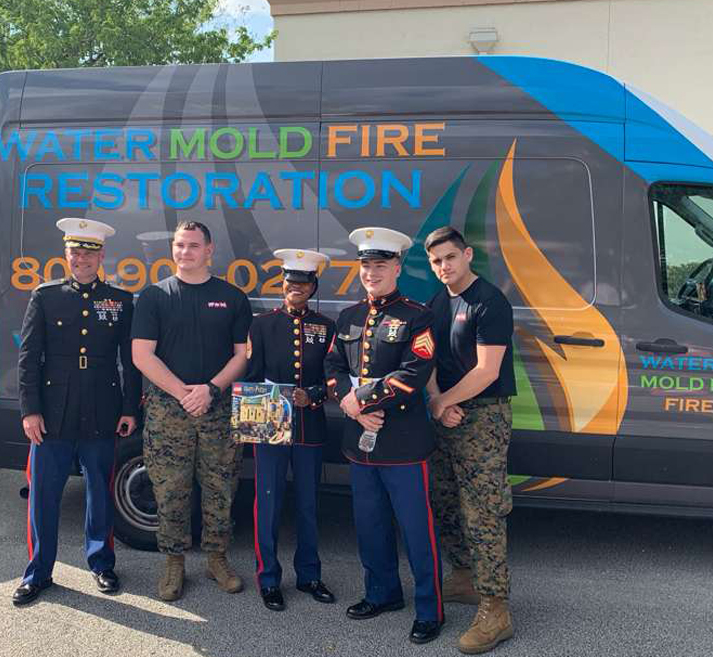
 Community & Military Support