Industry-Standard Mold Removal & Remediation in St. Louis
Mold in St. Louis is a year-round condition driven by the metro's humid continental climate, its 19th- and early 20th-century combined sewer infrastructure, the periodic catastrophic flash flooding the region produces, and a residential building stock dominated by pre-WWII red-brick rowhouses and four-family flats with limestone and brick foundation basements. With July and August relative humidity routinely above 70%, the post-August-2022 flash flooding wave that inundated tens of thousands of South City basements with Category 3 sewer-mixed water, the May 2024 EF3 tornado that opened envelopes across north and west St. Louis allowing wind-driven rain intrusion, and a Bevo Mill / Holly Hills / Soulard / Lafayette Square inventory of century-old brick stock with original galvanized supply pipe, St. Louis gives mold every condition it needs to colonize. Water Mold Fire Restoration of St. Louis is IICRC Firm Certified and performs mold remediation in accordance with the published industry consensus standard (the IICRC S520 Standard for Professional Mold Remediation) recognized by insurance carriers, indoor air quality professionals and the courts.
Why St. Louis Properties Develop Mold
Mold calls across the City of St. Louis, St. Louis County and the surrounding metro trace back to a handful of conditions specific to this market. We see the same patterns repeat in Bevo Mill and Holly Hills brick cottages, Dutchtown and Carondelet pre-WWII brick, Tower Grove South and Shaw rowhouses, Soulard and Lafayette Square Victorians, four-family flats across South City and the central corridor, The Hill Italianates, Central West End mansion stock, and the postwar stock that fills the inner-ring St. Louis County suburbs:
- South City basement moisture in stone-foundation brick stock. Pre-WWII St. Louis brick homes nearly all sit on limestone or brick foundation basements built before modern moisture management. Groundwater wicks through old stone walls; mortar joints fail; the half-finished basements common across Bevo Mill, Holly Hills, Carondelet, Dutchtown, Tower Grove South and the entire South City corridor stay damp year-round and produce chronic mold without continuous dehumidification.
- Post-August-2022 flash flood contamination. The July 25-26, 2022 flash flooding inundated tens of thousands of South City and inner-suburb basements with eight to nine inches of rain in six hours, sending Category 3 combined-sewer water through floor drains, laundry standpipes and showers across entire neighborhoods. Even with prompt extraction, residual biofilm and moisture seeded aggressive mold colonization that produced months of post-event remediation work. We are still occasionally working catch-up jobs on properties where the initial mitigation was incomplete.
- Post-May-2024 tornado envelope damage. The May 16, 2024 EF3 tornado that tracked through portions of north and west St. Louis opened roof envelopes, windows and exterior walls across affected properties. Wind-driven rain intrusion during the storm and subsequent rain events seeded attic and ceiling-cavity mold that often didn't become visible until weeks or months later. Tornado-driven secondary mold work is a recurring spring and fall category for St. Louis.
- Four-family flat cross-unit migration. The St. Louis brick four-family flat shares plumbing risers, common chases and party-wall systems. A leak in the upstairs unit produces mold in the unit below; landlord-tenant and HOA responsibility disputes routinely complicate the remediation timing. We work four-family flat jobs regularly across South City, Tower Grove and Central West End.
- Humidity, A/C condensate & air-handler colonization. St. Louis A/C systems run heavily from May through October. Clogged condensate lines, undersized returns and short-cycling oversized units produce persistent moisture inside air handlers and supply plenums. Air handlers are mold incubators in this climate, and contamination of the air-distribution system spreads spores building-wide before anyone notices.
- Post-frozen-pipe-burst contamination. Polar-vortex cold snaps in January and February produce predictable burst waves in St. Louis. When a burst happens while owners are out of town, drywall and framing sit saturated for days before discovery. Mold colonizes within 48 hours, and post-burst mold catch-up work runs through the spring.
- Hail-driven envelope failures. St. Louis sits in the corridor that produces the highest density of severe hail in the country. Major hail events damage roofs, gutters and window envelopes; the resulting water intrusion seeds attic and wall-cavity mold weeks after the storm, often discovered during a later roof project or a listing inspection.
- Original-era plumbing failures. Pre-WWII St. Louis stock — South City brick rowhouses, four-family flats, Soulard and Lafayette Square Victorians, Bevo Mill and Carondelet cottages, Central West End mansions — runs on galvanized supply pipe (pinholing from the inside out after 60-80 years) and cast-iron drain stacks (rusting through at hub joints). Slow chronic leaks behind tiled walls, under sinks and inside cabinets seed mold colonies that compound over months.
Credentials, Standards & What They Mean in Missouri
Missouri does not license mold assessment or mold remediation contractors at the state level, unlike Florida (which licenses both under Chapter 468 of the Florida Statutes), Texas, New York and a handful of other states. The Missouri Department of Health and Senior Services publishes consumer guidance on indoor mold, but no individual or company license is required to perform the work. That puts the burden on Missouri property owners to evaluate restoration companies on the credentials that actually substantiate the work.
The meaningful credentials are industry certification and adherence to the published consensus standards:
- IICRC Firm Certified. Firm-level certification from the Institute of Inspection, Cleaning and Restoration Certification — the recognized standards body for water damage restoration, mold remediation and fire and smoke damage restoration. Firm certification means the company itself operates under IICRC standards, not just individual technicians holding cards.
- Published industry consensus standard. We work to the IICRC S520 Standard for Professional Mold Remediation on every job — the ANSI-process industry consensus standard specifying containment design, negative-air pressure and HEPA filtration requirements, personal protective equipment, porous-material removal protocols, antimicrobial use, and the documentation expected for post-remediation clearance.
- Independent post-remediation verification. The EPA, IICRC and ASTM all recommend independent third-party post-remediation verification on significant jobs. Missouri doesn't require it, but we recommend it on insurance-driven and large-scope work to remove any conflict of interest from the final clearance decision. We perform our own mold inspection and testing service for smaller jobs and coordinate with independent indoor air quality assessors when independence is warranted.
Our Mold Remediation Process
Every job we run follows the IICRC S520 Standard for Professional Mold Remediation:
- On-site assessment. Visual inspection, moisture mapping, thermal imaging, identification of the moisture source (sewer backup, flash flood aftermath, frozen pipe burst, tornado envelope damage, hail-driven roof leak, A/C condensate, original plumbing failure, stone-foundation seepage).
- Containment setup. 6-mil polyethylene barriers, sealed HVAC vents, negative air pressure with HEPA scrubbers exhausted outside containment.
- Personal protective equipment. Tyvek suits, gloves, eye protection, N95 or half-face HEPA respirators.
- Removal of contaminated porous materials. Drywall, insulation, carpet, pad, baseboards, cabinetry, bagged inside containment and removed through a decontamination route.
- HEPA filtration & surface cleaning with EPA-registered antimicrobials.
- Moisture source repair. Plumbing, foundation seal, HVAC, sump pump installation or replacement, basement waterproofing, roof and envelope repair — whatever the source actually is, fixed as part of the same job.
- Post-remediation clearance. Visual verification and, on significant jobs, independent third-party post-remediation verification (PRV).
- Reconstruction. Drywall, flooring, cabinetry, paint and finish carpentry, coordinated with licensed Missouri trade subcontractors and properly permitted through the City of St. Louis Building Division or the relevant St. Louis County or municipal building department.
Types of Mold We Remediate in St. Louis
Common indoor molds we encounter on St. Louis area jobs include Stachybotrys chartarum ("black mold"), Aspergillus, Penicillium, Cladosporium and Chaetomium. The EPA, CDC and IICRC treat any indoor mold growth as a problem regardless of species, and the remediation protocol is essentially the same across genera. Species identification is the assessor's job; we work from the assessor's protocol or, on small unassessed jobs, from our own visual and instrument-based scope.
Where We Remediate Mold in St. Louis & the Metro
The City of St. Louis — Bevo Mill, Holly Hills, Dutchtown, Carondelet, Patch, Boulevard Heights, St. Louis Hills, Princeton Heights, Southampton, Tower Grove South, Tower Grove East, Shaw, Compton Heights, Benton Park, Cherokee Street, Soulard, Lafayette Square, The Hill, Botanical Heights, McRee Town, Midtown, Grand Center, Forest Park, Forest Park Southeast, Central West End, Visitation Park, Downtown, Washington Avenue Loft District, Old North St. Louis, Hyde Park. St. Louis County: Clayton, University City, Webster Groves, Kirkwood, Maplewood, Brentwood, Richmond Heights, Ladue, Frontenac, Town and Country, Chesterfield, Ballwin, Ellisville, Wildwood, Manchester, Crestwood, Affton, Mehlville, Florissant, Hazelwood, Maryland Heights, Bridgeton, Creve Coeur, Olivette. St. Charles County: St. Charles, St. Peters, O'Fallon, Wentzville.
St. Louis Mold Remediation FAQs
No. Missouri does not require state licensure for mold remediation or assessment, unlike Florida. The meaningful credentials are IICRC Firm certification and adherence to the published industry consensus standards.
Humid continental summers (70%+ RH), South City stone-foundation basements that wick groundwater year-round, combined sewer backups depositing Category 3 water during flash flood events, frozen pipe bursts, tornado-driven envelope intrusion, hail-driven roof leaks, A/C condensate during the long cooling season, and original galvanized plumbing pinholes in pre-WWII stock.
Not legally — Missouri doesn't license either side. But EPA/IICRC/ASTM recommend independent assessment before significant remediation, and many insurance carriers require it on larger jobs. EPA recommends professional remediation for any mold affecting more than 10 sq ft.
The IICRC S520 industry consensus standard. We are IICRC Firm Certified.
Yes — our single most consistent St. Louis category. Pre-WWII South City brick stock sits on limestone and brick foundation basements that accumulate groundwater seepage, take combined-sewer backflow during summer rain events, and trap A/C condensate. Finished basement conversions in older South City stock produce significant remediation scopes.
Yes — both events produced substantial post-event mold waves. The 2022 flash flooding inundated tens of thousands of basements with Category 3 sewer-mixed water; mold colonized in 24-72 hours and post-event remediation ran for months. The May 2024 EF3 tornado opened envelopes that seeded weeks-later wind-driven rain intrusion.
Yes. The St. Louis brick four-family flat is one of our most active multi-unit scopes. Historic-district properties (Soulard, Lafayette Square, Compton Heights, the Hill, Central West End historic blocks, Old North) require coordination with the St. Louis Cultural Resources Office for envelope-affecting work.
Small contained jobs run a few hundred dollars; large losses involving HVAC contamination, full South City basement remediation, four-family flat cross-unit work or whole-property post-flood remediation can run into the thousands. Written estimates after on-site evaluation.
Small contained jobs: 1-3 days. Larger jobs: 3-7 days plus reconstruction.
Call St. Louis's IICRC-Certified Mold Remediation Team
Water Mold Fire Restoration of St. Louis3958 Randall Street
Saint Louis, MO 63116
314-282-4140 · stlouis@watermoldfire.net
IICRC Firm Certified
Visible growth, musty South City basement smell, recent sewer backup, post-2022-flood remediation catch-up, or post-tornado attic concern? Call 314-282-4140 and we'll schedule an on-site evaluation.
← Back to all St. Louis restoration services
 IICRC Certified Firm
 Satisfaction Guaranteed!
 24/7 Emergency Service
 Expert Technicians
 Direct Insurance Billing
 Unsurpassed Customer Service
 No Damage We Can’t Manage!
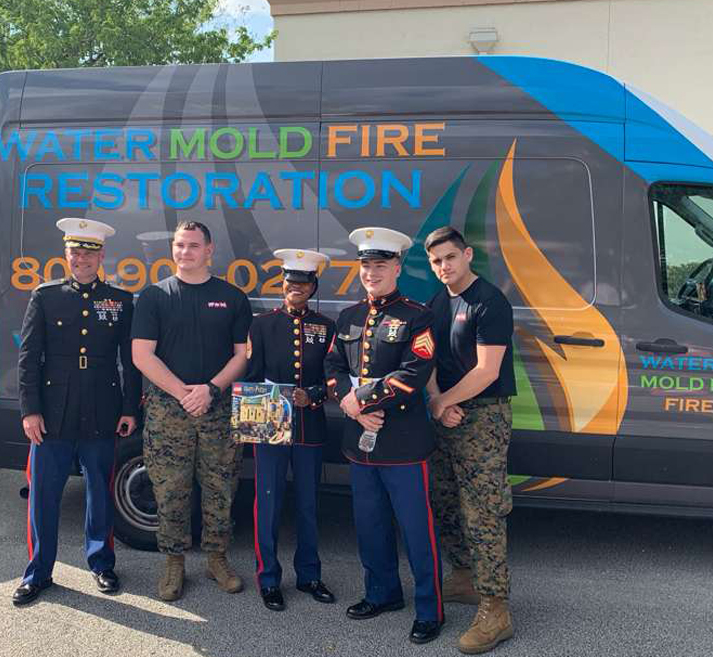
 Community & Military Support