24/7 Water Damage & Flood Cleanup for St. Louis Homes & Businesses
Water damage in St. Louis arrives from more directions than most Midwest cities. It comes up through finished basements in South City four-family flats and Bevo Mill brick cottages during summer thunderstorm sewer backups — most dramatically during the July–August 2022 historic flash flooding that dropped eight to nine inches of rain on parts of the metro in six hours and inundated tens of thousands of basements. It rises out of the Mississippi and Missouri Rivers during major spring flood events, most catastrophically during the 1993 Great Flood — the largest river flood by area in U.S. history — and again during the 2019 spring Missouri River flooding. It comes down through ceiling planes after Tornado Alley hail strikes a roof, after the May 16, 2024 EF3 tornado opened envelopes across portions of north and west St. Louis, and after every severe summer thunderstorm complex moving through the metro. Water Mold Fire Restoration of St. Louis handles all of it — IICRC Firm Certified crews dispatched 24 hours a day from our Bevo Mill facility on Randall Street with truck-mounted extractors, commercial-grade dehumidifiers, thermal imaging cameras and the documentation discipline Missouri insurance carriers expect.
The St. Louis Conditions That Drive Most Water Losses
We see the same loss patterns repeat across the City of St. Louis, St. Louis County and the surrounding metro, and most of them trace back to St. Louis's specific climate, infrastructure and building stock:
- Flash flooding & sewer backups during heavy rain. Older parts of the City and the inner-ring suburbs are served by combined sewer infrastructure that carries stormwater and sanitary sewage in the same underground pipes — which is why the Metropolitan St. Louis Sewer District's multi-decade Project Clear overhaul exists in the first place. Heavy summer thunderstorm rainfall drives backflow up through basement floor drains, laundry standpipes and showers across South City, the central corridor and the older suburbs. The July 26, 2022 event was the catastrophic recent benchmark — eight to nine inches of rain in six hours, two deaths, tens of thousands of inundated basements — but the steady baseline is dozens of smaller backups every summer storm season.
- Mississippi & Missouri River flooding. St. Louis sits at the largest river confluence in North America. The 1993 Great Flood remains the largest river flood by area inundated in U.S. history; the 2019 spring Missouri River flooding produced significant damage across St. Charles County and the Missouri bottomland; the 2017 Meramec River flooding hit properties from Pacific to Arnold; and every major spring runoff or upstream precipitation event since has pressured river-adjacent properties. River floodwater is Category 3 contamination carrying agricultural runoff, sewage and hydrocarbons.
- South City basement flooding through old infrastructure. Properties in Bevo Mill, Holly Hills, Carondelet, Dutchtown, Cherokee Street, Tower Grove South, Shaw, Benton Park and Soulard often sit on limestone or brick foundations a century old, with cellars or half-finished basements that were built before modern moisture management. Combined sewer backups, River des Peres backflow during heavy rain, groundwater seepage through old stone foundations, and chronic A/C condensate produce a steady stream of South City basement water work.
- Hail-driven envelope failures. St. Louis sits in the corridor that produces the highest density of severe hail in the country. Major hail events damage roofs, gutters and window envelopes; the resulting water intrusion often doesn't surface until weeks later when the next heavy rain finds the opening. Roof damage from hailstorms produces a months-long secondary water damage tail across the metro every major storm season.
- Frozen pipe bursts (Jan–Feb). Missouri winters produce predictable polar-vortex cold snaps that fail vulnerable plumbing. Exterior-wall supply lines in pre-WWII South City brick stock, unheated basement runs in four-family flat utility spaces, and the rural-edge properties out to Wildwood and St. Charles County all freeze and burst when temperatures hold below 10°F for multiple days. The bursts often happen during the thaw after the cold snap.
- Tornado-driven water damage. The May 16, 2024 EF3 tornado that tracked through portions of north and west St. Louis opened envelopes across affected properties — ripped shingles, broken windows, compromised roof-to-wall connections — producing wind-driven rain intrusion during the storm and subsequent rain events for weeks after. The St. Louis metro sits at the eastern edge of Tornado Alley and the western edge of Dixie Alley; severe wind events are a recurring spring and fall category.
- Four-family flat & multi-unit cross-unit cascades. The St. Louis brick four-family flat — the city's signature pre-WWII multi-unit residential building, found across South City, the central corridor and parts of the Central West End — shares plumbing risers, common chases and party-wall systems. A supply line break on an upper floor sends water through every unit below it. Cross-unit coordination and HOA or landlord management scheduling become as critical as the cleanup itself.
- Original-era plumbing in vintage St. Louis stock. Pre-WWII St. Louis housing — South City brick rowhouses, four-family flats, Soulard and Lafayette Square Victorians, Bevo Mill and Carondelet cottages, The Hill Italianates — still carries galvanized supply pipe (pinholing from the inside out after 60-80 years) and cast-iron drain stacks (rusting through at hub joints). Slow chronic leaks compound over months.
Basement Flooding, Sewer Backup & Flash Flood Cleanup in St. Louis
St. Louis basements flood for several distinct reasons — combined sewer backups, flash flooding that overwhelms storm drains, sump pump failures during power outages, groundwater seepage through old stone foundations, and rising river or River des Peres water — and the insurance treatment of each is different. Sewer backups are Category 3 contaminated water under the IICRC S500 standard ("black water"), carry raw sewage, and require full PPE, porous-material removal, antimicrobial treatment and verified cleaning. Sump pump failures generally start as Category 1 or 2 (clean groundwater) but degrade to Category 3 quickly if they go undetected for more than a day. Surface flooding from flash rainfall is Category 3 and is treated as flood under most insurance policies. River flooding requires NFIP or private flood coverage.
Our basement and flash flood cleanup process is built around that reality. We arrive in full PPE for any backup involving sewer or floodwater, extract standing water with truck-mounted pumps, remove and dispose of contaminated porous materials, apply EPA-registered antimicrobials to remaining structural materials, and deploy commercial drying equipment sized for the volume St. Louis basement floods actually produce. The August 2022 flash flooding produced jobs across South City and the inner suburbs that required full removal of drywall to the flood line, carpet and pad disposal, framing sanitization and weeks of structural drying for properties that had taken 36 to 48 inches of contaminated water in a single afternoon.
Important note on insurance: standard Missouri HO-3 homeowners policies do not include sewer/drain backup coverage. That coverage comes from a separate endorsement most carriers offer. Flash flooding from rainfall that overwhelms the storm drain system, and rising Mississippi, Missouri or Meramec River water, requires NFIP or private flood insurance. Many St. Louis homeowners purchased sewer backup endorsements for the first time after the August 2022 event and still don't carry NFIP flood coverage. We document cause-of-loss carefully on every job so the right carrier is billed for the right portion of the work.
Our Water Damage Restoration Process
Every job we run in St. Louis follows the IICRC S500 Standard for Professional Water Damage Restoration — the published industry consensus standard:
- Emergency response & assessment (Hour 1). Crew dispatch, source identification and shutoff, thermal imaging and moisture mapping. Documentation begins on minute one.
- Water extraction (Hours 1–6). Truck-mounted and portable extractors pull standing water. Category 3 sewer-backup and flood losses get full PPE and porous-material removal.
- Structural drying & dehumidification (Days 1–5). Air movers and LGR dehumidifiers create dry-air conditions. St. Louis's vintage brick construction and humid summer ambient conditions often extend this stage 24-48 hours past framed-wall norms.
- Antimicrobial treatment & mold prevention. EPA-registered antimicrobials applied to wet materials — non-negotiable in St. Louis's humid summer climate.
- Daily monitoring & documentation. Moisture readings, temperature and RH logged daily until materials hit dry standard.
- Reconstruction. Drywall, flooring, cabinetry, paint and finish carpentry, coordinated with licensed Missouri trade subcontractors and properly permitted through the City of St. Louis Building Division or the relevant St. Louis County or municipal building department.
Water Damage Categories We Handle
- Category 1 (clean water). Broken supply lines, refrigerator and ice-maker lines, water heater failures, frozen pipe bursts on the supply side, rainwater intrusion through a clean envelope.
- Category 2 (gray water). Dishwasher and washing machine discharge, toilet overflows (no feces), A/C condensate through contaminated pans, sump pump failures going stale.
- Category 3 (black water). Sewer backups (the dominant South City residential basement category), flash floodwater, Mississippi and Missouri River floodwater, River des Peres backflow. Requires material removal, full PPE and verified post-remediation cleaning.
Missouri Insurance & Documentation
Missouri's homeowners insurance market is stable — no hurricane-driven carrier exodus, consistent rate structure across the major carriers. But the policy structure has its own St. Louis-specific traps. Sudden and accidental water damage from supply-line and appliance failures is covered under a standard HO-3 policy. Sewer/drain backup coverage is a separate endorsement many St. Louis homeowners only realized they needed after the August 2022 flash flooding; typical limits of $5,000-$25,000 may be insufficient for a fully finished basement with kitchen and bath. Sump pump failure is typically tied to the sewer backup rider. Surface flooding from a heavy rainfall event that overwhelms storm drains, and rising Mississippi, Missouri or Meramec water, requires separate NFIP or private flood insurance. Hail-driven roof damage typically falls under a separate wind/hail deductible on Missouri policies. We build every St. Louis job file the way a Missouri adjuster needs to see it: thermal images, moisture maps, daily readings, photo logs and a clear written scope, and we coordinate directly with your adjuster.
Where We Respond in St. Louis & the Metro
The City of St. Louis — Bevo Mill, Holly Hills, Dutchtown, Carondelet, Patch, Boulevard Heights, Princeton Heights, Lindenwood Park, St. Louis Hills, North Hampton, Southampton, Tower Grove South, Tower Grove East, Shaw, Compton Heights, Benton Park, Cherokee Street, Soulard, Lafayette Square, The Hill, Botanical Heights, McRee Town, Midtown, Grand Center, Forest Park, Forest Park Southeast, DeBaliviere Place, Central West End, Visitation Park, Downtown, Downtown West, Washington Avenue Loft District, Laclede's Landing, Old North St. Louis, Hyde Park, College Hill, JeffVanderLou, The Ville, Penrose. St. Louis County: Clayton, University City, Webster Groves, Kirkwood, Maplewood, Brentwood, Richmond Heights, Ladue, Frontenac, Town and Country, Chesterfield, Ballwin, Ellisville, Wildwood, Manchester, Crestwood, Sunset Hills, Affton, Mehlville, Florissant, Hazelwood, Maryland Heights, Bridgeton, Creve Coeur, Olivette. St. Charles County: St. Charles, St. Peters, O'Fallon, Wentzville, Lake Saint Louis.
St. Louis Water Damage Restoration FAQs
Our St. Louis crews dispatch 24/7 from our Bevo Mill facility on Randall Street and target an on-site arrival of 60 minutes or less across the City, St. Louis County and the inner metro. During major storm events — the August 2022 flash flooding, the May 2024 tornado aftermath, river flooding events — we triage active leaks and Category 3 sewer-backup losses first.
Sudden and accidental water damage is generally covered under a standard Missouri HO-3 policy. Sewer backup is NOT — that requires a separate endorsement (typically $5,000-$25,000 in limits). Rising flood water (river flooding, flash flooding) requires separate NFIP or private flood insurance.
On July 25-26, 2022, parts of the metro received eight to nine inches of rain in roughly six hours — the heaviest single-day rainfall in city history. Two deaths, tens of thousands of inundated basements across South City and the inner suburbs, combined sewer system overwhelmed. Post-event mitigation work ran for many months.
Older City of St. Louis and inner-suburb sewer infrastructure is combined — stormwater and sanitary sewage share pipes. Heavy summer thunderstorm rainfall drives backflow up through basement floor drains and standpipes. The MSD Project Clear infrastructure overhaul is built to mitigate the problem; basement backups continue across South City and the central corridor every major rain event.
Yes — Category 3 ("black water"). Contains raw sewage and pathogens. Requires full PPE, porous-material removal, antimicrobial treatment and verified cleaning.
Yes. St. Louis sits at the largest river confluence in North America. The 1993 Great Flood was the largest river flood by area in U.S. history. The 2019 Missouri River event and the 2017 Meramec event also produced significant damage. River floodwater is Category 3 contaminated water.
Extraction and drying 3 to 5 days, often longer in vintage brick construction with solid walls and original plaster. Reconstruction adds 1 to 4 weeks depending on scope and the relevant City of St. Louis or St. Louis County permit timing.
Call the restoration company first. Missouri policies require mitigation. Mold colonizes within 24-48 hours in St. Louis's humid summer climate. We document cause-of-loss for your adjuster, then coordinate with your insurer.
Call St. Louis's Water Damage Restoration Team
Water Mold Fire Restoration of St. Louis3958 Randall Street
Saint Louis, MO 63116
314-282-4140 · stlouis@watermoldfire.net
24/7 Emergency Service
IICRC Firm Certified
Active sewer backup, basement flash flood, frozen pipe burst, or any water loss in St. Louis or the metro? Call 314-282-4140 and a crew will be rolling.
← Back to all St. Louis restoration services
 IICRC Certified Firm
 Satisfaction Guaranteed!
 24/7 Emergency Service
 Expert Technicians
 Direct Insurance Billing
 Unsurpassed Customer Service
 No Damage We Can’t Manage!
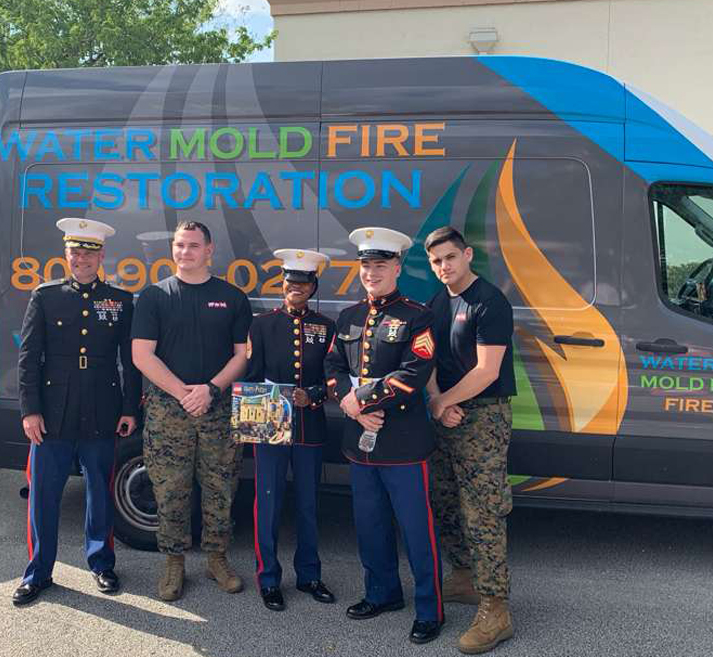
 Community & Military Support